
Consulting Firms' May 2026 Research Digest: AI Accountability, Capital Reordering, and a Softening Consumer
This monthly digest aggregates substantive research from McKinsey, BCG, Bain, Deloitte, and Accenture (Feb–May 2026), organized across four themes. AI: a convergence on measurable performance gaps between AI-embedded and lagging organizations. Finance: BCG's $333 trillion global wealth report, Bain's PE findings, and M&A's $4.9T rebound. Consumer: softening US travel, inflation-driven expectations erosion, and AI-agent-mediated commerce. Healthcare: thin coverage this cycle.

리서치 브리프
The five firms covered this month — McKinsey, BCG, Bain, Deloitte, and Accenture — published more than 60 research items between February and May 2026. The bulk of new, substantive reports landed in May, with a particular cluster on May 26–27 from BCG. Coverage skews heavily toward AI and Finance; Healthcare has the thinnest representation.
One cross-cutting thread runs through nearly all of this output: the "exploration phase" of enterprise AI is ending. Whether the framing is about physical automation, workforce transformation, wealth management disruption, or M&A underwriting, the recurring message is structural rather than experimental — AI is creating measurable performance gaps between early adopters and everyone else, and the window for unaccountable exploration is closing. BCG puts it directly: "The grace period for unaccountable AI exploration is ending." 1
AI: From experimentation to accountability
Physical AI and the automation economics shift
BCG's May 27 piece on Physical AI argues that the economic logic of industrial automation is fundamentally changing. Traditional automation systems are fixed-purpose: they are programmed for specific, stable tasks and break down when conditions change. Physical AI systems — robots and machines guided by trained neural models rather than fixed rules — can adapt to new scenarios by retraining their "brains" on the same hardware. 2
The business case for this flexibility is direct: relocating production from established manufacturing hubs typically causes a 4–15% efficiency drop. 2 Physical AI closes much of that gap by allowing retraining in simulation environments — often overnight, compared with weeks of human worker retraining in a physical facility. A Foxconn pilot cited in the report involved a constrained, retrofitted PCB assembly line where a single operator had to handle nine irregular component types; physical AI training resolved an automation problem the existing floor layout would have made impossible. 2
One global industrial company embedded agentic AI into its workflows and reported a 2 percentage-point EBITDA improvement over two years. 2 BCG's conclusion for CEOs: treat physical and agentic AI as strategic assets rather than cost items, and apply them where they can generate real, scalable impact — not as entry-level pilots on non-critical processes.
CEOs are committed to AI but not yet pressured on results
A separate BCG report, based on the firm's CEO Insomnia Index survey, surfaces a structural tension. 72% of surveyed CEOs say they are the primary AI decision-maker at their organization. 1 More than 90% plan to maintain or increase AI investment in 2026. 1 Yet when CEOs were asked to rank 11 sources of stress, "extracting bottom-line value from AI" came in ninth — below growth delivery, cost management, and meeting board expectations. 1 Only about 25% of CEOs report high stakeholder pressure to deliver AI returns within six months. 1
BCG's reading: boards are still asking "are you doing AI?" rather than "where is AI generating measurable impact?" That will change as cumulative investment rises and public commitments multiply. The practical implication for executives is to set explicit AI KPIs now — AI-driven revenue growth, quantifiable cost efficiency, measurable customer engagement — before the accountability shift arrives from above.
Embedded AI overtakes standalone tools
Deloitte's TMT Predictions 2026 forecasts that the number of people using generative AI embedded within existing applications (search engines, productivity tools, enterprise software) will surpass those using standalone generative AI tools. 3 The daily usage rate of embedded generative AI is projected to be 300% higher than standalone tools. 3 The underlying logic is friction: embedded AI requires no prompt engineering skills and fits into workflows users already know.
The adjacent market is large. The autonomous AI agent market is expected to reach $8.5 billion in 2026 and $35 billion by 2030; if enterprises improve agent orchestration — the ability to coordinate multi-agent systems reliably — the 2030 figure could reach $45 billion. 3
Agentic AI: wide deployment gap, shrinking cost barrier
Deloitte's Tech Trends 2026 provides the clearest picture of where enterprise AI actually stands operationally. Of 500 US technology leaders surveyed, only 11% have AI agents deployed in production; 38% are piloting; 42% are still formulating strategy; and 35% have no strategy at all. 4 Gartner's separate prediction puts a sobering ceiling on early deployments: 40% of agentic AI projects are expected to be cancelled before 2027. 4
The cost side has moved dramatically. AI token costs fell 280-fold over two years. 4 That collapse removes the "too expensive to experiment" argument, which is partly why the strategic question is shifting: the barrier is no longer cost, it is organizational readiness and workflow redesign.
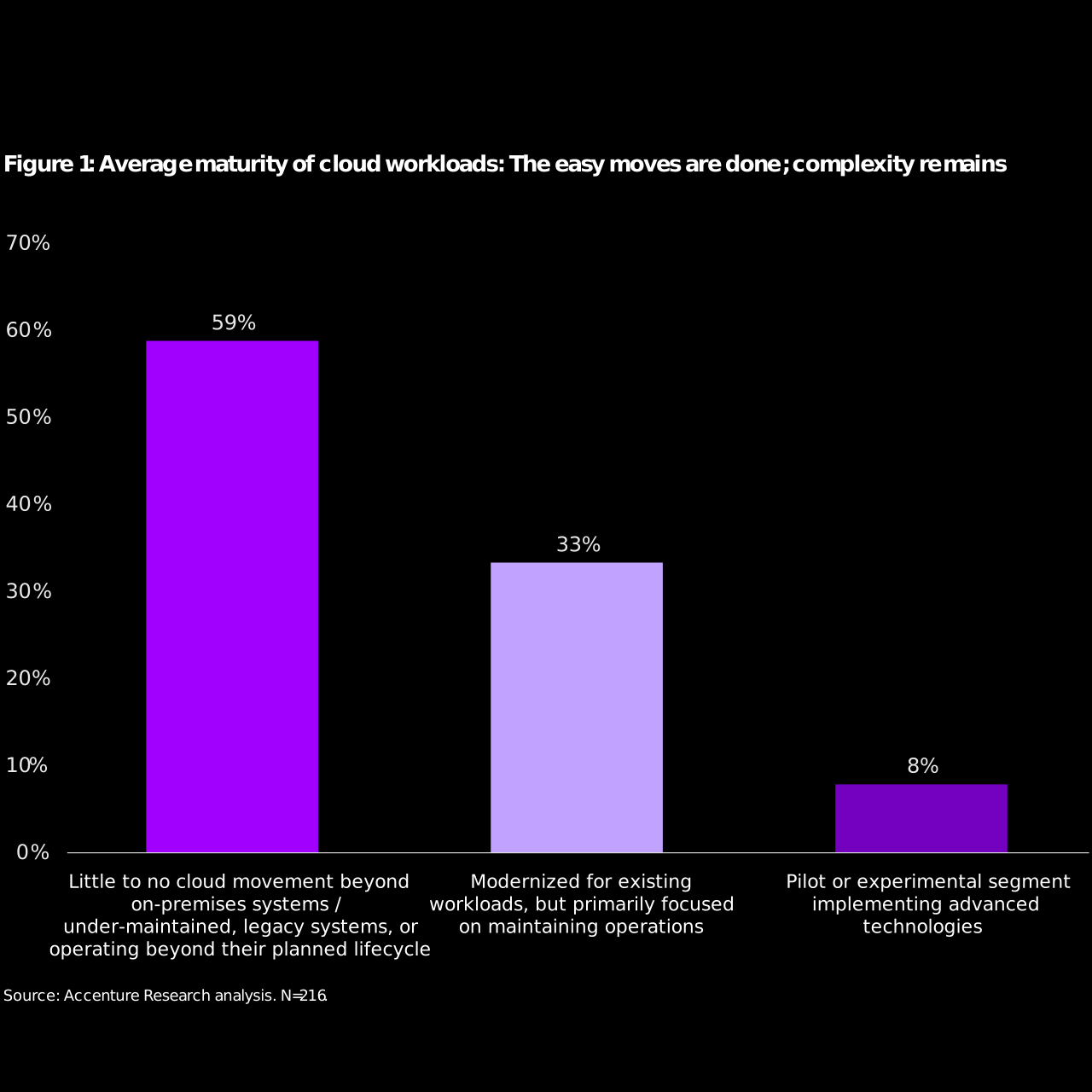
Accenture's cloud readiness assessment of 216 enterprises shows exactly where that constraint sits: 59% of core workloads remain on-premises or in legacy environments; only 8% are dedicated to experimenting with advanced technology. 5 Full automation has been achieved by 0% of "Stabilizer" and "Optimizer" companies (roughly 93% of the assessed pool) and by only 29% of the top tier "Innovators." 5
AI workforce split: 18% at the frontier, 50%+ overloaded
Accenture's Talent Reinventors report — based on a survey of 1,300+ C-suite executives and 4,500 workers across 20 industries — identifies a widening performance gap rooted in how organizations handle AI and people simultaneously. Only 18% of organizations currently balance AI adoption with a people-first mindset; Accenture labels these "Talent Reinventors." 6 In 2025, Talent Reinventors posted revenue growth 1.8 percentage points higher and profit growth 1.4 percentage points higher than peers. 6
The gap in workforce infrastructure is notable: Talent Reinventors are 16.5 times more likely to have dynamic, AI-informed skills data embedded in their systems. 6 Among the broader workforce, 50%+ of workers report cognitive overload, 31% report burnout, and 23% report loss of agency — signals that AI deployment without deliberate workforce redesign is generating friction rather than capacity. 6
Accenture and the Wharton School's joint Age of Co-intelligence report (March 2026) frames this at a higher level of abstraction, introducing the Wharton Accenture Skills Index (WAsX) to map job tasks against economic value creation in a world of human-AI collaboration. 7 The report's central argument: AI has shifted from simple augmentation — doing tasks faster — to co-intelligence, where AI interprets intent, reasons through options, and coordinates cross-functional work. The human role is to remain "in the lead" by setting direction, defining guardrails, and owning outcomes.
McKinsey's MGI published a Europe-focused counterpart, Agents, Robots, and Us, in May 2026: the report's headline finding is that most skills will still be needed, but how people apply those skills will change fundamentally as they collaborate with intelligent machines. 8 Detailed methodology was unavailable for this issue due to access restrictions.
Finance: wealth concentration, a tougher PE era, and AI reordering banking
Global wealth grew 10.7% — and its geography is shifting
BCG's 2026 Global Wealth Report — the firm's annual flagship financial data release — documents that global financial wealth grew 10.7% in 2025 to $333 trillion, the fastest pace since 2021. 9 Total net wealth including physical assets reached $550 trillion (+9.3%). 9 By asset class: equities +13.2%, physical assets +7.4%, and gold approximately +44%. 9
The report projects global financial wealth to grow at a 7% CAGR through 2030, contingent on geopolitical tensions and energy disruptions easing in the second half of 2026. 9
Global financial wealth rose 10.7% in 2025. 9
Cross-border wealth — assets booked in a country other than the owner's home jurisdiction — grew 8.4% to $15.6 trillion. The top 10 booking centers accounted for over 90% of new flows and hold over 80% of the stock. 9 In 2025, Hong Kong overtook Switzerland for the first time as the world's largest cross-border booking center, both at $2.9 trillion, but Hong Kong growing at +10.7% versus Switzerland's +7.6%. 9 Singapore attracted over 2,000 single-family offices and grew cross-border assets 10.3%; UAE reached $721 billion (+11.1%). 9
Regional growth rates in 2025: China +15%, Western Europe +15.3%, Middle East/Africa +12.3%, Asia-Pacific (ex-China) +9.2%, North America +7.4%. 9
Hong Kong overtook Switzerland as the world's largest cross-border booking center in 2025. 9
Where the next wealth wave comes from: emerging markets
A second chapter of the BCG GWR 2026 focuses on emerging markets. By 2030, emerging markets are projected to add $12 trillion in financial wealth, or roughly 10% of total global wealth growth. 10 The affluent-and-above segment (assets of $250,000+) is expected to grow at 8% annually through 2030, adding over 1 million new millionaires. 10
Country-level projections: India +$2 trillion, Brazil +$1 trillion, Mexico +$600 billion by 2030. 10 The structural opportunity: affluent clients in these markets typically represent less than 10% of a retail bank's customer base but contribute 40–50% of deposits. 10 Capturing this segment could accelerate fee income growth by more than 50% over five years. 10
Asia's succession crisis in family wealth
The third GWR chapter addresses a slow-motion structural issue in Asian family business. Close to 50% of large Asian enterprises are still founder-led, with median founder leadership age exceeding 70 across the region. 11 In Singapore, Malaysia, and Indonesia, 40–50% of major companies remain founder-led at that median age. 11 Most families are still at early stages of formal succession governance — no charters, no family councils, no structured separation of ownership from management. BCG's framing: "One of the greatest wealth transfers in history is underway in Asia." 11 The recommendation for wealth managers is to position as "system architects" helping families design ownership and governance structures, not just product distributors.
AI is structurally disrupting wealth management
The fourth GWR chapter examines AI's impact on the wealth management industry. Earlier in 2026, a US fintech's announcement of an AI tax-planning feature caused $140 billion in market cap to evaporate from several listed wealth managers in a single session — investors read the move as a structural displacement signal rather than incremental competition. 12
Two years ago, large language models hallucinated too frequently for client-facing deployment. By 2026, AI can independently draft financial plans, generate portfolio management logic, and automate compliance documentation. 12 The structural implication: AI removes the "Dunbar's number" constraint on relationship depth — a human advisor can maintain roughly 150 effective social relationships; AI-augmented advisors have no comparable ceiling. BCG distinguishes between two disruption scenarios: full replacement (unlikely as a first wave) versus the more probable "AI-first" model where firms expand the entire value chain while retaining human advisors for relationship-intensive work, compressing fees and widening coverage simultaneously.
Private equity: "12 is the new 5"
Bain's 14th annual Global Private Equity Report describes the industry as undergoing a K-shaped recovery — a minority of top-performing funds are pulling away while the majority grind through a difficult environment. The math behind this divergence is the report's most cited insight: in 2015, a typical buyout required 5% annual EBITDA growth to achieve a 2.5× return over five years, with leverage of roughly 50%, entry multiples of 10.0× and exit multiples of 12.5×. The same return today requires 12% annual EBITDA growth — higher interest rates (8–9%), lower leverage (30–40%), and compressed multiple expansion leave no room for passive value capture. 13
The headline market data from 2025 was strong: global PE deal value reached $904 billion (+44% year-on-year), the second-highest figure on record; exit value hit $717 billion (+47%). 14 But 13 mega-deals above $10 billion accounted for $274 billion of that total, and deal count actually fell 6% to 3,018 transactions. North America contributed 80% of deal value growth. The recovery was real but highly concentrated. Undeployed capital (dry powder) stands at $1.3 trillion; unrealized assets total $3.8 trillion across roughly 32,000 companies with an average holding period of approximately seven years. 14
The GP survey (conducted jointly with StepStone, covering 103 investment and IR professionals) shows 79% of GPs expect valuation multiples to be flat in 2026, and valuation disagreement remains the leading cause of deal failure. 15 Management fee pressure is also structural: average fees have declined to 1.6% from 2% a decade ago, while co-investment at a median of 33 cents per committed dollar compresses fee income by roughly 25%. 15 On AI at portfolio companies: 39% of GPs do not expect AI to generate material financial impact on their holdings in 2026. 15
M&A rebounded 40% in 2025 — three forces drive 2026
Bain's M&A Report 2026 records that global deal value rebounded to $4.9 trillion in 2025 (+40%), lifting M&A as a share of GDP from 3.2% to 4.2%. 16 A survey of 300+ senior M&A executives shows 80% expect to maintain or increase deal activity in 2026, even as M&A's share of total capital allocation sits at a 30-year low — squeezed by Magnificent 7-level AI infrastructure spending ($500 billion in capex from a handful of US tech firms). 16
Bain identifies three structural forces shaping 2026 dealmaking: technology disruption (nearly half of tech deals in 2025 contained an AI element), post-globalization supply chain reordering (tariff pressure driving cross-border acquisitions), and profit pool migration (streaming and social commerce upending traditional industry economics). 17 Frequent acquirers demonstrate a durable advantage: 75% reach or exceed their synergy targets, versus significantly lower rates for infrequent buyers. 16
Accenture's Dawn of the Agentic Deal (March 2026) covers the AI-augmented side of M&A: a survey of 650 senior dealmakers finds that "insights-driven leaders" — the 27% of firms with mature data practices — are 4.6 times more likely to have deployed and scaled agentic AI across the M&A lifecycle, and 2.7 times more likely to use AI as a catalyst for integration value. 18 67% of deal professionals say their teams need upskilling to collaborate effectively with AI agents. 18
Banking: six trends, $13 trillion at risk
Accenture's Top Banking Trends for 2026 puts a specific figure on the stakes of payment system disruption: $13 trillion in transaction value could shift to alternative payment methods by 2030, putting $13 billion in payment fee revenue at risk. 19 A full build-out of scaled generative AI across the top 200 global banks could generate $289 billion in benefits over the next three years. 19 The six trends: smart money (digital currencies and agentic payments), banking everywhere (conversational and embedded experiences), agentic AI breaking capacity ceilings, the cost of accumulated technical debt (~70% of IT budgets consumed by legacy maintenance), integrated risk management, and fintech/stablecoin competition for deposits. 19
McKinsey's Global Banking Annual Review 2026 frames the environment around four themes: an emerging new geopolitical world map, a customer ownership inflection point, AI reshaping the industry at unprecedented speed, and banks evolving into multi-speed organizations that run core operations at one pace while testing new models at another. 20 Detailed supporting data was unavailable due to access restrictions.
The McKinsey Institute for Economic Mobility published a separate finance-adjacent report (February 2026) on the US small business ownership transfer wave: approximately 6 million small businesses face ownership transitions by 2035 due to baby boomer retirements, representing up to $5 trillion in enterprise value. 21 Closing participation gaps for women and Black and Latino owners could unlock up to $3 trillion in new household wealth. 21
Consumer: travel softens, fandom holds, AI enters the shopping cart
US travel intent hits a six-year low
Deloitte's 2026 Summer Travel Survey (4,003 US respondents, fielded April 2–9) finds that only 45% plan to take a vacation this summer — the lowest share in six years. 22 The market is polarizing rather than uniformly declining. High-income households (annual income $100,000+) are expected to account for 55% of all travelers (up from 50% in 2025), and the share planning to increase their flagship trip budget rose from 19% in 2025 to 24%. 22 High-income millennials are the standout segment: over 80% plan to travel, at 1.2× the frequency and 1.6× the budget of other groups, and 43% are using generative AI for trip planning. 22 Meanwhile, 51% of Americans earning below $100,000 say travel spending is the first item cut when costs rise. 22
Consumer confidence is eroding on expectations, not reality
Deloitte's State of the US Consumer report (April–May 2026) shows the Financial Well-Being Index fell to 101.1 in March, down 4 points from February — driven by future expectations rather than current conditions. 23 82% of respondents expect oil prices to rise (up 35 percentage points month-on-month, the highest in three years); 74% expect food prices to rise. 23 Headline inflation reached 3.3% in March — the highest in nearly two years — driven by energy prices. 23 The personal savings rate dropped to 4%, a signal that spending is outpacing income. 23
Fans are the stickiest media audience — and AI agents are entering commerce
Deloitte's 2026 Digital Media Trends survey (3,575 US consumers) identifies fans as the media industry's most valuable and durable asset: 80% of consumers self-identify as fans of at least one entertainment category. 24 Fans spend 51 more minutes per day on media than non-fans (+16%) and pay a monthly SVOD average of $71 across four services, compared to $56 for non-fans across three. 24 52% discover new content primarily through social media; among Gen Z fans that rises to 73%. 24
In adjacent consumer territory, Accenture's Agentic Commerce report (April 2026) signals a structural shift in how products get bought: 90% of frequent AI users in North America say they would switch from a preferred brand if their AI assistant offered a better alternative. 25 Accenture's simulation work (February 2026) suggests up to 45% of shoppers may shift at least half of their commerce activity into agent-mediated ecosystems within two years. 25 25% of executives already say AI agents will be their primary content audience within three years — surpassing search engines. 25
Healthcare: signal-level coverage this month
Healthcare was the thinnest theme across all five firms' May output. Substantive findings require detail pages that were inaccessible during research; the entries below reflect summary-level information.
McKinsey noted that provider-led health plans are underrepresented in the commercial group insurance market, with more than $20 billion in potential revenue and $700 million in operating profit uncaptured — a market positioning gap the firm frames as an addressable strategic opportunity. 26
Deloitte's health care research published a finding that reducing health inequities could unlock $2.8 trillion in US economic growth. 27 A separate Meharry School of Global Health / Deloitte joint analysis put the cost of mental health inequities in the US at $14 trillion between 2026 and 2040. 28 A third Deloitte piece examined why US women skip or delay medical care, though detailed findings were not accessible at time of publication. 29
Broader healthcare and life sciences industry outlooks from Deloitte and McKinsey were published during the period but inaccessible in detail.
Cover image: Accenture Talent Reinventors social image via Accenture
참고 출처
- 1BCG: AI Isn't Keeping CEOs Up at Night
- 2BCG: Physical AI Will Reshape the Economics of Automation
- 3Deloitte: TMT Predictions 2026
- 4Deloitte: Tech Trends 2026
- 5Accenture: AI Innovation Is Nonstop. Your Cloud Foundation Should Be Too.
- 6Accenture: Talent Reinventors
- 7Accenture: The Age of Co-intelligence
- 8McKinsey Global Institute: Agents, robots, and us
- 9BCG: 2026 Global Wealth Report: The Great Reordering
- 10BCG: 2026 Global Wealth Report — Where the Next Wave of Wealth Is Coming From
- 11BCG: 2026 Global Wealth Report — The Succession Reckoning
- 12BCG: 2026 Global Wealth Report — AI and the New Economics of Wealth Management
- 13Bain & Company: Global Private Equity Report 2026
- 14Bain: Private Equity Outlook 2026: Gaining Traction
- 15Bain & Company / StepStone: GP Outlook 2026
- 16Bain & Company: M&A Report 2026
- 17Bain & Company: Looking Ahead to 2026 M&A
- 18Accenture: The Dawn of the Agentic Deal
- 19Accenture: Top Banking Trends for 2026
- 20McKinsey: Global Banking Annual Review 2026
- 21McKinsey Institute for Economic Mobility: The Great Ownership Transfer
- 22Deloitte: 2026 Summer Travel Survey
- 23Deloitte: State of the US Consumer: April–May 2026
- 24Deloitte: 2026 Digital Media Trends
- 25Accenture: Agentic Commerce: Make Your Brand Unmissable
- 26McKinsey: How provider-led health plans can succeed in commercial insurance
- 27Deloitte: Health equity economic impact
- 28Deloitte: Mental health inequities cost
- 29Deloitte: Why women skip or delay health care
이 콘텐츠를 둘러싼 관점이나 맥락을 계속 보강해 보세요.