Bay Area Median Sale Prices — April/May 2026
Bay Area housing pulse: SF sets a 26-year overbid record as rates climb to 6.65%
The Bay Area housing market is bifurcating this week: SF recorded a $1,687,500 median sale price (+19% YoY) and set a 26-year luxury overbid record ($15M on a $7.95M ask), while Oakland (−3.3%), Contra Costa County (−3.6%), and Santa Clara County (−1.5%) all show year-over-year declines. The 30-year fixed rate climbed to 6.51–6.65%, putting monthly P&I on a $1.4M Bay Area median home above $7,100. On policy: the federal ROAD to Housing Act passed the House 396–13, a state ballot measure targeting municipal transfer taxes was certified for November, and SF's Affordable Housing Guarantee Act qualified for the November ballot.

The Bay Area housing market is splitting into two separate stories. San Francisco and San Mateo are getting more competitive and more expensive. Oakland, Concord, and Santa Clara County are softer — prices are down year-over-year, even as bidding wars continue. Stitching both stories together is a shared headwind: the 30-year fixed mortgage rate has climbed 30 basis points in five weeks and now sits between 6.51% and 6.65% depending on the source. On a $1.4M Bay Area median home with 20% down, that rate puts the monthly principal-and-interest payment at roughly $7,100–$7,200 — not including property taxes or insurance.
Here is this week's snapshot across the four tracked dimensions.
Quick-scan summary
| Dimension | This week's reading | Direction |
|---|---|---|
| SF median sale price (Redfin, Mar) | $1,687,500 (+19.0% YoY) | ↑ |
| Santa Clara Co. ZHVI (Zillow, Apr) | $1,669,878 (−1.5% YoY) | ↓ |
| Contra Costa Co. ZHVI (Zillow, Apr) | $787,968 (−3.6% YoY) | ↓ |
| 30-yr fixed rate (Freddie Mac, May 21) | 6.51% (+15 bps week-over-week) | ↑ |
| 30-yr fixed rate (Bankrate, May 27) | 6.62% | ↑ |
| MBA mortgage applications (week of May 22) | −8.5% overall; refi −18% | ↓ |
| NAR pending home sales — West (Apr) | +0.4% MoM | → |
| SF luxury overbid record | $15M on $7.95M ask (+88.7%) | ↑ |
Prices and inventory: premium areas pull away
San Francisco's median sale price hit $1,687,500 in March 2026 — up 19.0% year-over-year — with 66.2% of March closings above list price and a sale-to-list ratio of 113.7% 1. The Zillow Home Value Index (ZHVI) — a smoothed, seasonally adjusted measure of typical home value across all properties — shows a more modest reading of $1,369,171, up 6.0% year-over-year as of April 30 2. The divergence reflects methodology: Redfin's figure tracks actual March closings (which skewed toward higher-priced transactions), while ZHVI covers the full stock of homes rather than only what sold.
統計カードを読み込んでいます…
San Mateo city recorded a median of $1,650,000 in March (+6.8% YoY), with sellers typically collecting 6–7% above asking price 3.
East Bay and South Bay tell the opposite story. Oakland's median fell to $870,000 in March (−3.3% YoY) 4, and Santa Clara County's ZHVI declined to $1,669,878 (−1.5% YoY) — the only county in this sample showing a year-over-year ZHVI drop 5. Contra Costa County's ZHVI fell further to $787,968 (−3.6% YoY), with the county's sale-to-list ratio sitting at exactly 1.000 — sellers are getting precisely their asking price, a signal of a balanced rather than a seller's market 6.
One counterintuitive pattern worth noting: Concord and Oakland both post very high Redfin "Compete Scores" (92 and 89 out of 100, respectively) despite falling prices. Buyers in those markets are still bidding aggressively — there are simply too few homes at the budget ranges that constrained buyers can afford. The competition is real; the price direction is not a sign of low demand but of budget caps hitting a ceiling.
Mortgage rates: five-week climb, affordability tightening
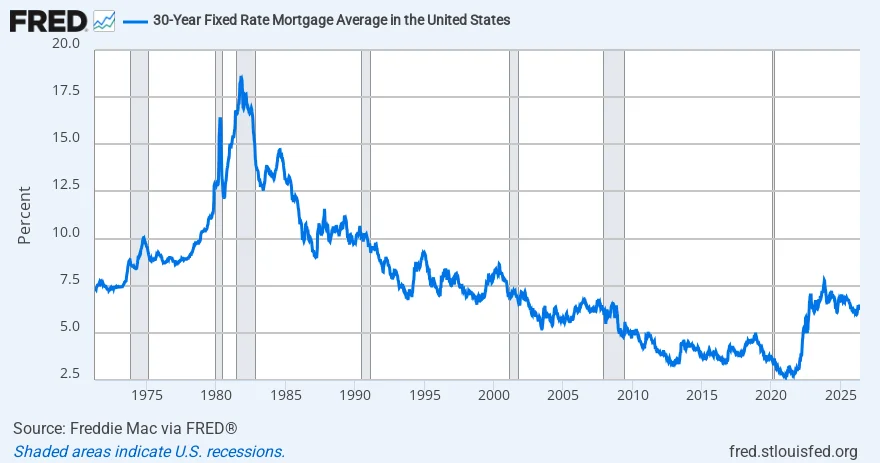
The 30-year fixed rate has risen steadily since late April.
統計カードを読み込んでいます…
Freddie Mac's Primary Mortgage Market Survey (PMMS) — compiled from thousands of loan applications via Freddie Mac's Loan Product Advisor — clocked 6.51% for the week ending May 21, up from 6.36% the prior week and the largest single-week increase in five weeks 8. The 15-year fixed moved to 5.85% from 5.71% 8.
By May 27, Bankrate's daily aggregate showed the 30-year reaching 6.62%, up from a 2026 low of 6.09% on February 18 — a cumulative rise of 53 basis points 9. Different aggregators show a spread: NerdWallet's 30-year APR (which includes lender fees) sits at 6.40%, while Forbes Advisor's panel shows 6.875% 10 11. The spread reflects different lender samples and fee assumptions rather than contradictory market signals.
On a Bay Area median-priced home of $1,400,000 with 20% down ($280,000), a loan of $1,120,000 at 6.62% produces a monthly principal-and-interest payment of roughly $7,168 9. At Freddie Mac's 6.51%, that drops to about $7,087. Add California property taxes (~$1,283/month at 1.1% annually) and homeowners insurance, and the all-in monthly cost comfortably exceeds $8,400.
Denise McManus, a global real estate advisor at APEX Residential, attributed the rate rise to broader geopolitical and inflationary pressures: "Inflation is still not fully behaving, and global tension continues to keep oil and bond markets on edge. That kind of uncertainty tends to keep pressure on rates, even when there are brief moments of relief." 9
MBA forecasts the 30-year rate will stay near 6.50% through 2026 and into 2027; Fannie Mae's projection is slightly lower, at 6.30% for the remainder of 2026 12.
30-year fixed rate weekly average (FRED / Freddie Mac): climbed from 6.09% (Feb 18) to 6.51% (May 21), a gain of 42 basis points over 13 weeks 8
Market signals: applications drop, luxury sets records
The rate climb is showing up in borrower behavior. The Mortgage Bankers Association's (MBA) weekly composite index — which tracks the volume of mortgage applications submitted to lenders — fell 8.5% in the week ending May 22, the steepest weekly drop in five weeks. Refinance applications were hit harder, tumbling 18%, as higher rates killed the math for most existing borrowers. Purchase applications were nearly flat at −0.4%, and remain 5% above year-ago levels 13.
MBA's Joel Kan noted that "the 30-year fixed rate has increased 30 basis points over the past five weeks to its highest level since August 2025. With the rate now at 6.65 percent, many borrowers understandably backed away from refinancing last week." 13 The average purchase loan size hit a survey record of $473,600 — Kan's read: buyers with smaller loan amounts have stepped back under affordability pressure, leaving higher-balance borrowers as a larger share of the pool 13.
Nationally, NAR reported April pending home sales up 1.4% month-over-month and 3.2% year-over-year, with the West gaining a modest 0.4% month-over-month 14. NAR chief economist Lawrence Yun warned that "unless supply meaningfully increases, home price growth could outpace wage growth and further erode the homeownership rate" 14.
Zillow revised its full-year 2026 home sales growth forecast down from roughly +4% to just +1.2% (Zillow basis) and cut its national home value growth forecast to essentially flat at +0.1%, citing persistent energy-price-driven inflation and the resulting rate pressure 15. Zillow economist Mischa Fisher framed the Fed's challenge plainly: "Members are primarily wrestling with a genuinely difficult decision-making environment where the data really is sending conflicting signals." 15
Against that backdrop, the luxury end of SF continues to perform as if rates barely exist. On May 8, a Cow Hollow property at 2512 Union Street — a 5,700-square-foot, six-bedroom home built around 1900 — closed at $15,000,000 on a $7,950,000 asking price, a premium of 88.68% ($7.05M over ask). That's the highest overbid rate for any SF property priced above $5M in 26 years 7. The home went from listing to signed contract in 8 days — a pace that implies an all-cash transaction. Compass broker Nina Hatvany, who previously represented the property, offered a candid take: "If they aren't that price-sensitive, it makes sense to make a bid that just blows the competition out of the water and secures them a house." 7
That sale was not an outlier. April 2026 Compass data cited by the SF Standard showed 85% of SF homes sold above list price, a median overbid of 24.6% (a record), and a citywide median sale price of $2.15M — above the 2022 peak — with 26 sales above $5M, including four above $10M 7. SF's active listing count stood at just 835 single-family homes as of April 1, against a typical seasonal norm closer to 1,100.
Policy: three items with direct Bay Area impact
Federal — ROAD to Housing Act passes the House 396–13. On May 20, the House passed H.R. 1299, the 21st Century ROAD to Housing Act, with near-unanimous bipartisan support 16. The bill — co-authored by Senate Banking Committee Chair Tim Scott (R-SC) and Ranking Member Elizabeth Warren (D-MA) — contains 56 provisions, including a $200M annual Innovation Fund for local governments that increase housing supply through permitting reform or zoning changes, expanded CDBG (Community Development Block Grant) eligibility for new affordable construction, streamlined NEPA environmental review, and raised FHA multifamily loan limits 17. The bill also adds a new restriction on large institutional investors buying single-family homes. The Senate must now either adopt the House version or enter conference to reconcile differences.
State — transfer tax cap ballot measure heads to November 2026. California's Secretary of State certified a statewide proposition for the November ballot that would cap municipal real estate transfer taxes at 0.05% of sale price and require two-thirds voter approval for certain local tax increases 18. The Howard Jarvis Taxpayers Association is backing the measure; its primary target is Los Angeles' Measure ULA, which has generated over $1 billion for affordable housing since 2023 by taxing sales above $5M at 4% and above $10M at 5.5% 18. The most recent polling shows 57% of likely voters opposing the measure, and backers have until June 25 to withdraw it. The direct Bay Area relevance: San Francisco's own real estate transfer tax structure could be subject to a similar cap if the measure passes.
Local — SF Affordable Housing Guarantee Act on the November ballot. A companion measure qualified for San Francisco's November 2026 ballot that would dedicate all revenue from Proposition I's real estate transfer tax — which has generated over $400 million since 2020 and is projected at roughly $100 million annually — exclusively to affordable housing production, preservation, and tenant stabilization 19. The proposal also includes provisions to lower transfer taxes on certain new construction projects, which backers say would encourage building.
Cover image: FRED 30-Year Fixed Rate Mortgage Average in the United States, as of May 21, 2026. Source: Federal Reserve Bank of St. Louis (FRED)
参考ソース
- 1Redfin: San Francisco Housing Market
- 2Zillow: San Francisco, CA Housing Market
- 3Redfin: San Mateo Housing Market
- 4Redfin: Oakland Housing Market
- 5Zillow: Santa Clara County, CA Housing Market
- 6Zillow: Contra Costa County, CA Housing Market
- 7San Francisco Standard: This mansion just set SF's 21st-century record for overbidding
- 8Freddie Mac: Primary Mortgage Market Survey
- 9Bankrate: Today's mortgage rates, May 27, 2026
- 10NerdWallet: 30-year mortgage rates, May 27, 2026
- 11Forbes Advisor: Today's Mortgage Rates
- 12Yahoo Finance: Mortgage and refinance rates today, May 26, 2026
- 13MBA: Mortgage Applications Decrease, May 27, 2026
- 14NAR: Pending Home Sales Report Shows 1.4% Increase in April
- 15Zillow: Home Value and Sales Forecast, May 2026
- 16NLIHC: House Passes Amended Bipartisan '21st Century ROAD to Housing Act'
- 17Bipartisan Policy Center: What's in the 21st Century ROAD to Housing Act
- 18CalMatters: Ballot measure puts LA's mansion tax on the chopping block
- 19CP&DR: News Briefs April 28, 2026
このコンテンツについて、さらに観点や背景を補足しましょう。