BTC retreats, new US crypto rules arrive

BTC retreats, new US crypto rules arrive

A three-month bootstrap roundup (Feb 27 – May 27, 2026): BTC gained +14.4% before a CPI-driven reversal; stablecoin supply plateaued at $322.6B; DeFi TVL contracted to $81.6B; and the US classified BTC/ETH/SOL as digital commodities while Hong Kong issued first stablecoin licenses and the EU accelerates MiCA CASP authorizations ahead of July 1.

Crypto Weekly Digest
2026/5/27 · 21:19
購読 1 件 · コンテンツ 1 件
Three months of data, four dimensions: here is what happened to BTC/ETH prices, stablecoin liquidity, DeFi capital flows, and crypto regulation between February 27 and May 27, 2026 — and what each dimension signals for the weeks ahead.

Quick scan

DimensionKey moveDirection
BTC price$67,387 → $77,092 (+14.4% period); peak $81,594 May 14, then -5.5% reversal↑ then ↓
ETH price$2,033 → $2,125 (+4.5% period); underperformed BTC throughout↑ weak
BTC ETF cumulative flows$56.8B lifetime net inflow; $2.51B net outflow in 10 trading days following May 12 CPI print↓ recent
Stablecoin total supply$322.6B, effectively flat (+0.60% 30d)
DeFi total TVL$81.6B; Lido -16.6%, EigenCloud -30.9%; Ethena +26.1%, Morpho +10.3%↓ mixed
US regulationToken Taxonomy classifies BTC/ETH/SOL/XRP as commodities; GENIUS Act implementation underwayClarity
HK regulationFirst stablecoin licenses granted April 10 (Anchorpoint/HSBC)Open
EU regulation20+ new CASP authorizations; July 1 grandfathering deadline approaching; EC launches MiCA reviewTightening

Price action and macro

BTC and ETH: a two-act quarter

BTC opened the window at $67,387 (week of Feb 26) and closed it at $77,092 (week of May 21), a net gain of +14.4% over 13 weeks. 1 The path was uneven. The first act ran through early May: prices ground higher, punctuated by one standout week (April 2–9, +8.0%, $66,796 → $72,118) 1 as ETF inflows accelerated and pre-CPI risk appetite improved. BTC touched its period high of $81,594 the week of May 14 before the second act began.
ETH followed a similar arc but with notably less momentum: $2,033 at the open, $2,125 at the close, +4.5% over the same span. 2 ETH peaked at $2,326 the week of April 23, already pulling back while BTC was still climbing — a divergence worth tracking as a DeFi liquidity indicator.
チャートを読み込んでいます…

ETF flows: $833M in, then $2.51B out

Bitcoin spot ETFs have accumulated $56.8B in lifetime net inflows since launch. 3 Within this period, the clearest ETF signal was a two-phase swing. The April 6–10 window saw three sessions of heavy buying: +$471.4M on April 6, +$358.1M on April 9, +$256.7M on April 10 — a combined $833M over the week, the strongest inflow cluster of the period. 3 BlackRock's IBIT held $64.6B in cumulative net inflows, while Grayscale's GBTC continued its structural outflow trend at -$26.5B cumulative.
The reversal came fast. The April CPI print — released May 12 — triggered what the flow data shows as an abrupt sentiment shift. On May 13, net outflows hit -$630.4M. May 18 set the period's worst single-day reading at -$648.6M. Over 10 trading days (May 13–22), BTC ETFs bled a net -$2.51B, with only one positive session in that span (+$131.3M on May 14). 3 ETH ETFs showed parallel outflows over the same stretch. 4

The macro backdrop: rates held, energy drove CPI

The Federal Reserve held the federal funds target range at 3.50–3.75% across all three FOMC meetings in this period (January 28, March 18, April 29). 5 Internal dissent grew with each meeting. Governor Stephen Miran voted for a 25bp cut at all three sessions. By April, three additional voting members — Hammack, Kashkari, and Logan — did not oppose the rate hold but objected to the easing-bias language in the statement, signaling a more hawkish tilt within the committee. The April statement noted explicitly: "Inflation is elevated, in part reflecting the recent increase in global energy prices." 6
That assessment was borne out by the CPI sequence. Year-over-year inflation ran 3.0% in January, 2.8% in February, fell to 2.4% in March, then jumped to 3.8% in April — a 140bp swing driven almost entirely by energy: the energy component rose +17.9% year-over-year in April, with gasoline up +28.4% and fuel oil up +54.3%. 7 Core CPI held steadier in the 2.7–2.8% range, but the April core month-over-month reading of +0.4% was the highest of the year. For crypto markets, the practical read is straightforward: as long as energy drives headline CPI above 3.5%, rate cuts remain off the table, and ETF flow data will continue to trade the Fed calendar.

Stablecoin liquidity

A $322B market that stopped growing — but didn't stop moving

Total stablecoin supply across all chains stood at $322.6B as of May 27, tracked across 380 stablecoins. 8 The seven-day change was -$36.8M (-0.01%), and the 30-day change was +0.60% — effectively flat. The headline masks substantial rotation beneath it.
Issuer-level breakdown (May 27 snapshot): 8
StablecoinSupply30d changeNotes
USDT (Tether)$189.3B-0.50%58.67% market dominance
USDC (Circle)$76.6B+0.30%Stable
USDS (Sky/MakerDAO)$8.77B+3.25%Former DAI issuer
USD1 (World Liberty Financial)$4.77B+2.41%New entrant; see below
DAI$4.61B+0.31%Gradual structural decline
USDe (Ethena)$4.45B+1.78%+18.3% broader-period growth
PYUSD (PayPal)$3.49B-0.64%Slight contraction
BUIDL (BlackRock)$3.03B-3.86%Chain rebalancing; see below
RLUSD (Ripple)$1.78B+1.81%Steady post-launch growth
USDtb (Ethena)$1.13B+78.6%*T-bill-backed; *broader period
Three rotations worth watching:
USD1's emergence. The stablecoin issued by the Trump-affiliated World Liberty Financial project reached $4.77B in total supply across six chains (Ethereum $1.92B, Solana $991M, plus BSC, Aptos, Tron, and Monad), overtaking DAI to become the fourth-largest stablecoin. 8 Growth at this speed — from near-zero to a top-five position in a matter of months — is unusual among stablecoin launches. Whether supply reflects genuine end-user demand or politically-connected minting activity is not determined by on-chain data alone; exchange reserve inflow/outflow data (not yet available for this period) would clarify.
USDT's exit from Solana. USDT supply on Solana fell -31.36% over 30 days, dropping from approximately $3.55B to $2.44B, while USDC on Solana held at $7.54B. 9 The likely interpretation is a Solana DeFi preference shift from USDT to USDC — though without exchange flow data the mechanism is an inference, not a confirmed read.
BUIDL's chain rebalancing. BlackRock's tokenized T-bill fund BUIDL fell -17.82% on Ethereum (30d) while surging +161% on Solana, bringing Solana's BUIDL to $603M. 9 Total BUIDL supply declined only -3.86% overall — this reads as active chain rebalancing by institutional holders rather than demand destruction. Why Solana is the destination is worth monitoring: lower settlement costs, growing institutional DeFi activity, and Unichain overlap may all be factors.
One other notable data point: Ethereum's stablecoin base added +$4.37B in a single week (+2.76%), even as the 30-day figure remained -2.29%. 10 That week-on-week surge, set against a negative month, suggests short-term capital rotation back into Ethereum DeFi rather than a sustained trend reversal.

DeFi TVL: real yield vs. hype

Snapshot: $81.6B total, with sharp divergence

Total DeFi TVL stood at $81.6B as of May 27. 11 The 30-day picture is a study in divergence: protocols generating real fees or offering structural yield held ground or grew; protocols dependent on restaking narratives or points programs lost significant capital.
統計カードを読み込んでいます…

The event that defines the period: KelpDAO

On April 18, an attacker exploited a flaw in how KelpDAO validated cross-chain messages via LayerZero (a protocol for passing messages between blockchains), minting 116,500 rsETH tokens without backing. The unbacked rsETH was deposited into Aave as collateral to borrow approximately $190M in real ETH, leaving Aave with estimated bad debt of $123M–$230M. 12 Aave's own contracts were not exploited — the attack vector was the composability risk built into DeFi's interconnected structure. The immediate market reaction flushed roughly $13B in TVL from the ecosystem.
The recovery was coordinated. By April 27, a coalition called DeFi United — comprising Consensys, Lido, EtherFi, Mantle, and the Aave DAO treasury — had committed over $300M in ETH toward covering losses and restoring liquidity. 12 The speed and scale of industry coordination was notable; a response of this kind did not exist in 2022.

Protocol-level moves

Aave launched V4 on Ethereum mainnet on March 30, introducing a hub-and-spoke lending architecture that separates liquidity management from individual markets. The "Aave Will Win" governance proposal routes 100% of product revenue to the DAO and funds active AAVE token buybacks. 13 Despite the KelpDAO bad-debt impact, Aave's 30-day TVL declined only -2.48%, reflecting its position as the category default. Current TVL: $14.2B across 21 chains, with Ethereum holding $11.6B. Annual revenue: $85.4M.
Lido had the most significant protocol-level governance action: the DAO approved a $20M LDO buyback using treasury stETH, which triggered roughly a 30% price recovery in LDO. 14 The GOOSE-3 strategic proposal sets a target of staking 1M ETH through V3 stVaults (institutional-grade stETH wrappers) by end of 2026. TVL is down -16.6% over 30 days ($18.5B), partly reflecting a post-exploit flight from liquid staking protocols. LDO currently trades at approximately $0.34 against an ATH of $7.30.
EigenCloud (the rebranded EigenLayer) lost -30.9% in 30-day TVL, with EIGEN at $0.24 vs. an ATH of $5.65. 15 The protocol generates no direct revenue — all rewards go to supply-side participants — and has a cumulative net loss of -$160.7M. Restaking narratives have not translated into protocol economics. The Spark Protocol (a MakerDAO/Sky lending fork) saw the steepest TVL decline of any top-10 protocol: -40.2% over 30 days, with 7-day and 30-day figures nearly identical (-39.6% vs. -40.2%), suggesting the decline was concentrated in the past week.
Ethena was the standout gainer: +26.1% TVL over 30 days, reaching $5.49B. 16 The protocol's synthetic dollar (USDe) is backed by delta-neutral ETH positions, generating yield from perpetual funding rates. Its newer T-bill-backed product, USDtb, saw +78.6% supply growth over the broader period. Q1 2026 protocol revenue: $65.1M.
Uniswap activated its fee switch — routing 17% of trading fees toward UNI token buybacks and burns — on Ethereum in December 2025, expanding to Optimism, Arbitrum, Base, and four other chains on March 8. 17 Q2 2026 Token Holder Net Income reached $5.9M. Weekly DEX volume held at $8.15B even through the post-KelpDAO 15% sector-wide volume decline, and Uniswap's own Unichain L2 now handles approximately 50% of V4 transaction volume.

Regulation: US, Hong Kong, and EU

Three months produced more structural regulatory clarity in the US than had emerged in the preceding several years.
Token Taxonomy. On March 17, the SEC published interpretive release 33-11412 (jointly with the CFTC), establishing a five-category classification for crypto assets: Digital Commodities, Digital Collectibles, Digital Tools, Stablecoins, and Digital Securities. 18 Sixteen specific assets — including BTC, ETH, SOL, XRP, ADA, AVAX, DOT, and LINK — were explicitly classified as Digital Commodities and therefore not securities. The release also defined an "investment contract severance" mechanism: tokens subject to securities law can exit that classification once their issuer has completed its obligations and the network is sufficiently decentralized. Protocol staking rewards, mining rewards, and airdrops of non-security tokens were each explicitly excluded from securities regulation.
SEC Chair Paul Atkins framed the release as ending "more than a decade of uncertainty," stating directly: "most crypto assets are not themselves securities." 18
SEC-CFTC MOU. On March 11, the two agencies signed a memorandum of understanding and established a Joint Harmonization Initiative covering six areas: product definitions, clearing and margin frameworks, dual-registration friction, crypto-adapted regulatory structures, data reporting, and cross-market enforcement coordination. 19 A second MOU — between the SEC and the National Futures Association — was signed May 21. 20
GENIUS Act rollout. The FDIC issued two rulemaking proposals under the GENIUS Act (the stablecoin-specific US legislation): a prudential framework for permitted payment stablecoin issuers (April 7, covering reserve assets, redemption, capital, and risk management) 21 and a Bank Secrecy Act / sanctions compliance standard (May 22, requiring AML/CFT programs aligned with FinCEN and OFAC rules). 22 Both are out for 60-day public comment.
Clarity Act. A second legislative track — the Clarity Act — remained in debate as of late May. House Majority Whip Tom Emmer pushed back against law-enforcement concerns about its developer-protection provisions, calling those concerns "overstated." 23 Alongside the already-enacted GENIUS Act, the Clarity Act would form a two-statute framework for US crypto law — but its timing and final form remain uncertain.
Enforcement posture. The SEC formally disclosed that since February 2025 it has dismissed seven major crypto enforcement cases: Coinbase, Cumberland DRW, Consensys, Kraken/Payward, Dragonchain, Balina, and Binance. 24 David Woodcock was appointed as the new Director of Enforcement on April 8.

Hong Kong: first stablecoin licenses issued

On April 10, the HKMA (Hong Kong Monetary Authority) granted the city's first stablecoin issuer licenses under the Stablecoins Ordinance to two entities: Anchorpoint Financial Limited (a joint venture of Standard Chartered Hong Kong, Animoca Brands, and Hong Kong Telecom HKT) and The Hongkong and Shanghai Banking Corporation Limited (HSBC's Hong Kong banking entity, one of the city's three note-issuing banks). 25
Both licenses are effective immediately; the issuers are expected to complete preparations and launch products within months. HKMA Chief Executive Eddie Yue described the decision as "an important milestone for the development of digital assets in Hong Kong." 25
The path to April 10 had a detour. HKMA had signaled a March target, and as of April 1, the public register still showed zero licensed issuers. The delay was attributed to the rigor of the framework itself — full reserve backing, one-business-day redemption, and a physical Hong Kong presence are among the requirements. Reports also pointed to caution following mainland Chinese regulators (the People's Bank of China and the Cyberspace Administration of China) expressing reservations, which reportedly prompted Ant Group and JD.com to pause their Hong Kong stablecoin plans in October 2025. 26 The first two licensed issuers are both bank-affiliated — consistent with a deliberate strategy of anchoring the initial cohort in institutions that already underpin the Hong Kong dollar.

EU: July 1 grandfathering deadline and an accelerating authorization wave

The EU's Markets in Crypto-Assets Regulation (MiCA) — the EU's comprehensive crypto asset framework covering both stablecoin issuers and crypto asset service providers (CASPs) — entered full application in December 2024. Two dynamics are now unfolding simultaneously.
Authorization wave. ESMA's (European Securities and Markets Authority) Interim MiCA Register was updated as recently as May 22. In the Feb 27–May 27 window, at least 20 CASPs received new MiCA authorization, including Circle Internet Financial Europe (France, April 23), Coinhouse (France, May 7), CAIXABANK (Spain, March 27), Berenberg (Germany, March 6), Scalable Capital Bank (Germany, March 2), and CheckSig (Italy, May 6). 27
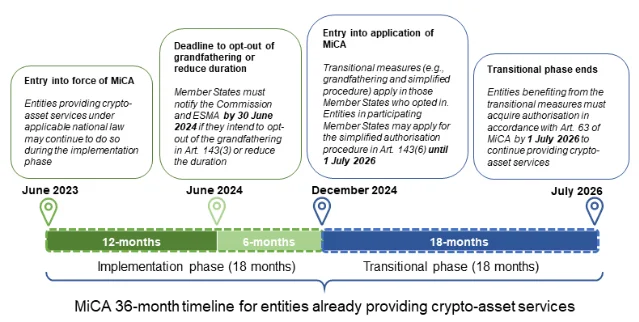
MiCA 36-month transitional timeline from ESMA
MiCA 36-month implementation path: from June 2023 entry into force to the July 1, 2026 grandfathering cutoff. 27
July 1 grandfathering cutoff. Under MiCA Article 143(3), CASPs that were already providing services legally under national law before December 30, 2024 have been permitted to continue operating during a transitional "grandfathering" period — but that window closes July 1, 2026 for the 22 member states that opted for the maximum 18-month transition. 28 Countries with shorter windows (Germany, Ireland: 12 months; Netherlands, Poland: 6 months) already passed their deadlines in late 2025. CASPs without authorization in those jurisdictions have already had to stop operating. The July 1 date is the single most consequential near-term compliance milestone in the EU's crypto calendar.
MiCA review. On May 20, the European Commission launched parallel public and targeted consultations to assess whether MiCA remains "fit for purpose" in light of market developments since its December 2024 application date. 29 Both consultations close August 31. The Commission has explicitly flagged that the review report may be accompanied by new legislative proposals to amend MiCA — meaning the framework is already being evaluated for updates less than 18 months after it came into force.

What to watch next. The June CPI print (released in July) is the most direct near-term trigger for BTC ETF flows given how sharply the April data moved the market. On the regulatory side, the GENIUS Act comment periods (both FDIC proposals) close in late June and late July respectively; July 1 is the MiCA grandfathering hard stop; and the Clarity Act's legislative path in the US House remains the most uncertain variable in the US regulatory picture.
Cover image: AI-generated illustration

このコンテンツについて、さらに観点や背景を補足しましょう。

  • ログインするとコメントできます。